DECIDE: Sharing Municipal Data Across Borders—With Verification Instead of a Key
For sixteen months, [ui!] demonstrated in the European pilot project DECIDE how a German city can use licensed data from a Flemish government agency. The result has been running as a prototype since July 2026 and is now publicly documented, including a video and architectural details, at decide.ui.city.
| What It’s About
DECIDE is one of the pilot projects of the Data Space for Smart and Sustainable Cities and Communities (DS4SSCC), the European data space for municipalities. On the Flemish side, the lblod program of the Agency for the Interior (ABB) publishes local government decisions as Linked Open Data; the city of Ghent provides the data. On the German side, [ui!] represents the pilot cities of Freiburg and Bamberg and is implementing the two use cases: traffic-restricted zones on the map and a search function for decision data.
The core question of the pilot: Can a government agency in one country demonstrate that it is authorized to use data from a government agency in another country—and do so in a way that can be applied to other cities?
| What [ui!] has built
A system that has been in production since July 2026, interfacing with the Flemish platform, consisting of two core components:
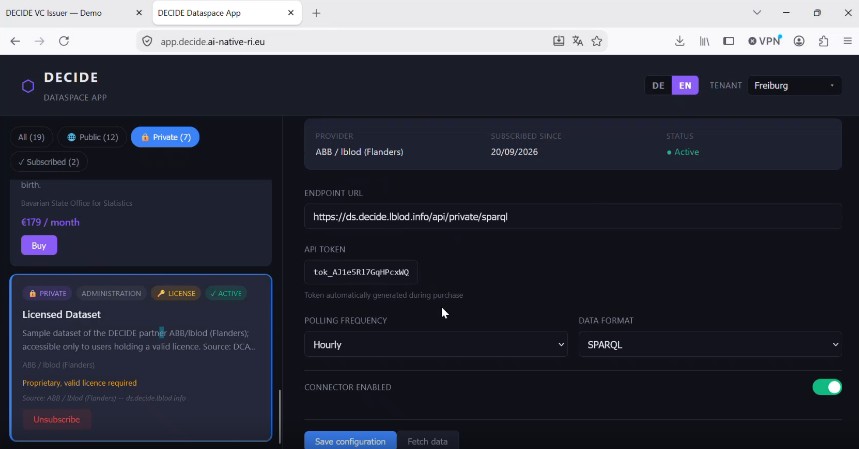
The DECIDE Dataspace App is the user interface for the data space—a complete application featuring a catalog, license management, and retrieval history, available in two languages for city employees. Three features make all the difference:
- Find and license. The catalog displays the datasets along with their licenses and access conditions, as described by the Flemish DCAT catalog.
- Verify before purchasing. The purchase gateway requires proof from the wallet when acquiring a license and verifies the issuer, signature, and license level. Without a valid credential, no license is granted.
- Retrieve and use. The Data Space Connector retrieves the licensed dataset in real time from the Flemish endpoint and logs each retrieval with a timestamp, status, and scope. The map view and search function operate directly on the retrieved data.
The DECIDE Credential Issuer issues German cities their authorization as a verifiable credential, directly into a standard smartphone wallet. The same credential unlocks the purchase gateway in the app and enables login on the Flemish site: an authorization issued in Germany is recognized in Flanders.
Together, these elements form the pilot’s trust loop: Identity verifies the license level, and the data layer utilizes it. The architecture page shows, block by block, how the components interact in detail.
| Why This Matters for Municipalities
With the eIDAS 2.0 Regulation, digital wallets are coming for all citizens of Europe; the Data Governance Act and the Data Act require controlled data exchange across organizational boundaries. DECIDE demonstrates on a small scale how the two fit together: data with a license, authorization with proof, and open standards at every interface. No proprietary middleware. A new city needs credentials, a catalog entry, and the documented interfaces—nothing more.
| Watch
In this five-minute video, project manager Lisa Brunzel guides viewers through the live systems. The architecture page explains each building block and the six steps a city goes through: decide.ui.city
Partners: ABB Agentschap Binnenlands Bestuur (Lead), City of Ghent, [ui!] Urban Software Institute, City of Freiburg, City of Bamberg, Kehl University of Applied Sciences, University of Jena.