Smart City Pilot Project in Dietzenbach
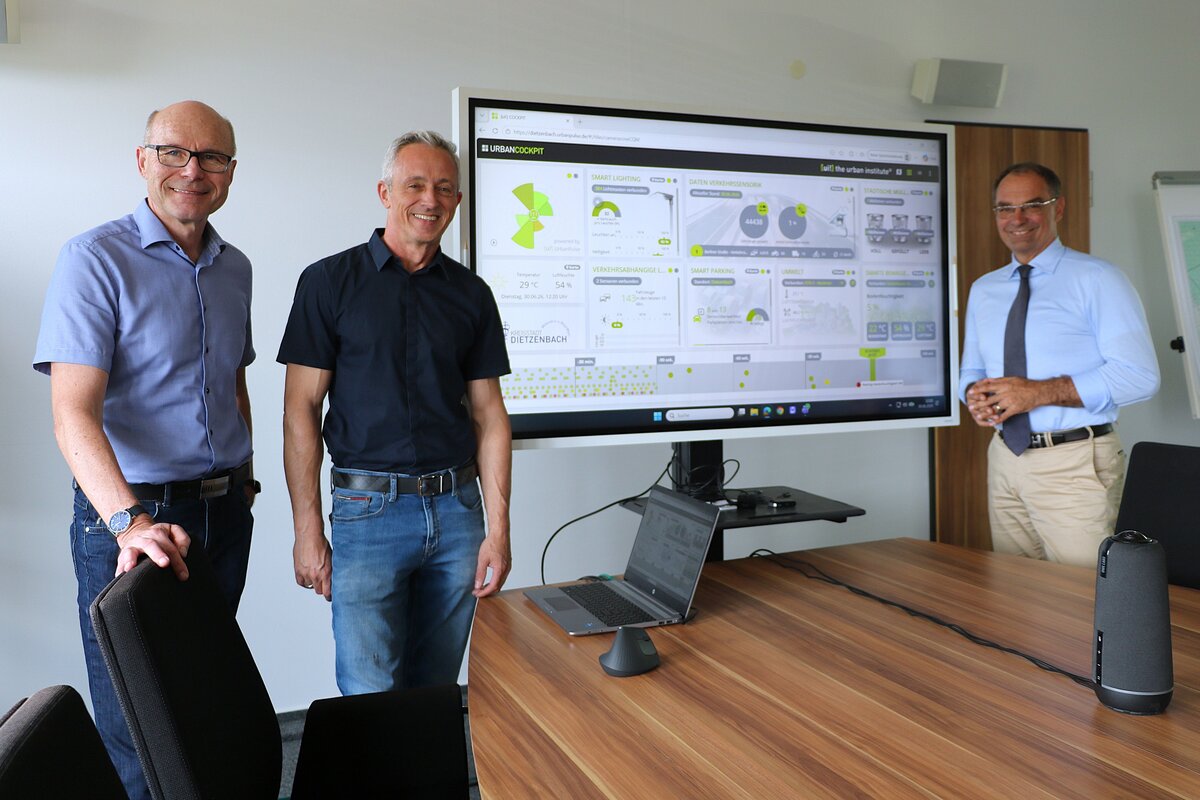 A pilot project pays off—a joint look at the data: Mayor Dr. Dieter Lang (right), together with Dr. Karsten McGovern (Managing Director of LandesEnergieAgentur LEA Hessen, left) and Matthias Weis (Managing Director of [ui!] Urban Lighting Innovations GmbH, second from left), provided information about the “Smart Infrastructure LED Street Lighting” project in Dietzenbach.. Source: www.dietzenbach.de
The Smart City pilot project in Dietzenbach.
Rising energy costs, climate goals, and limited budget resources are putting many municipalities under pressure. But one city in Hesse is fighting back.
The county seat of Dietzenbach, which Hesse’s Minister of Economic Affairs Kaweh Mansoori has called an “energy pioneer city,” demonstrates the potential of smart infrastructure.
- Over 80% reduction in energy consumption for street lighting
- Approximately 320,000 kWh saved per year
- About 96,000 euros in annual cost savings
- Approximately 121 metric tons less CO₂
How are these savings even possible?
The existing infrastructure was modernized and digitally upgraded:
The replacement of streetlights with energy-efficient LED technology was combined with a digital lighting management system. Sensors and smart controls take actual usage in the urban space into account.
- Lighting responds to movement.
- Traffic volume is factored in.
- Light output is adjusted as needed.
This has significantly reduced energy consumption, operating costs, and emissions.
A significant part of the implementation is led by Matthias Weis, Managing Director of [ui!] Urban Lighting Innovations. Together with the city of Dietzenbach, the existing street lighting was gradually transformed into an intelligently controllable infrastructure: from the conversion to LED technology, through the integration of sensors, to digital control during ongoing operations.
But it’s not just about light. The networked infrastructure provides data, adapts to real-world usage scenarios, and lays the foundation for further smart city applications in the municipal context.
Dietzenbach is the only demonstration municipality in Hesse that uses such a system in live operation and showcases how smart lighting systems function in the everyday life of a city.
The project is continuing: More lights are being integrated, additional data sources are being incorporated, and new control concepts are being tested.
The further development is funded, among other sources, by the Federal Ministry for the Environment’s municipal guidelines with approximately 900,000 euros.
Long-term benefits for municipalities: lower energy consumption, reduced operating costs, lower emissions, and additional leeway for important tasks.
Total energy savings at a glance:
- 318,133 kWh: Savings from LED retrofitting
- 2,090 kWh: Savings from adaptive control (bike path and forest road)
- 609 kWh: Savings from traffic-dependent control
You can find the full article on the City of Dietzenbach’s smart city pilot project on the city’s website: Read the article.